#3rdSem results out. Pass huney walas lai badhai. Back haru note it http://ift.tt/1q8Ru2E
News mirrored from: CSIT Authority


The naming format CSC-351-SE-L-05 provides the following information: Software Engineering Lab Assignment#5.
Other abbreviations indicate the following: L=LAB Assignment, T=Theory Assignment, HC=HardCopy, SC=Softcopy, R=Report
*Similar Naming convention will be used to complete and upload assignments. Assignments can be viewed and uploaded in the panel below this notice.
{SubjectCode}-{SubjectAbbr}-{LABorTHEORY}-{AssignmentNumber}-{[YourIDoptional]}
example, for Software Engineering Lab Assignment#5, use::
CSC-351-SE-L-05.docx OR, CSC-351-SE-L-05-013BSCCSIT055.docx [Giving your ID is optional].
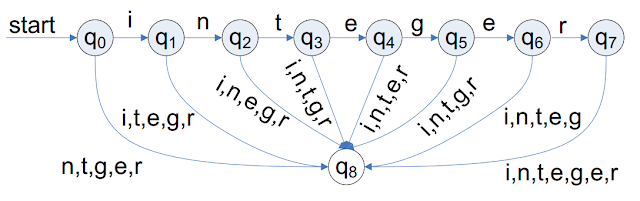
| i | n | t | e | g | r | |
|---|---|---|---|---|---|---|
| q0 | q1 | q8 | q8 | q8 | q8 | q8 |
| q1 | q8 | q2 | q8 | q8 | q8 | q8 |
| q2 | q8 | q8 | q3 | q8 | q8 | q8 |
| *q3 | q8 | q8 | q8 | q4 | q8 | q8 |
| q4 | q8 | q8 | q8 | q8 | q5 | q8 |
| q5 | q8 | q8 | q8 | q6 | q8 | q8 |
| q6 | q8 | q8 | q8 | q8 | q8 | q7 |
| *q7 | q8 | q8 | q8 | q8 | q8 | q8 |
| q8 | q8 | q8 | q8 | q8 | q8 | q8 |
public class DFAwithdeadend {
    public static void main(String[] args) {
        // Implement DFA that accepts 'int' or 'integer'
        int count;
        String state_now="q0",
               final_state1="q3",final_state2="q7";
        Scanner sc= new Scanner(System.in);
        System.out.print("Enter a string to test:");
        String string= sc.nextLine();
        HashMap i = new HashMap();
        HashMap n = new HashMap();
        HashMap t = new HashMap();
        HashMap e = new HashMap();
        HashMap g = new HashMap();
        HashMap r = new HashMap();
        HashMap deadend = new HashMap();
        i.put("q0","q1");
        n.put("q1","q2");
        t.put("q2","q3");
        e.put("q3","q4");
        g.put("q4","q5");
        e.put("q5","q6");
        r.put("q6","q7");
        for(count=0;count<=8;count++){
            String rem_state="q"+count;
            if (count!=0)
                i.put(rem_state,"q8");
            if (count!=1)
                n.put(rem_state,"q8");
            if (count!=2)
                t.put(rem_state,"q8");
            if (count!=3 && count!=5)
                e.put(rem_state,"q8");
            if (count!=4)
                g.put(rem_state,"q8");
            if (count!=6)
                r.put(rem_state,"q8");
            deadend.put(rem_state, "q8");
        }
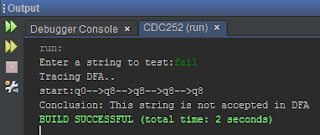
        System.out.print("Tracing DFA..\nstart:q0");
        for(count=0;count<string.length();count++){
            if(string.charAt(count)=='i'){
              state_now=(String)i.get(state_now);
            }
            else if(string.charAt(count)=='n'){
                state_now=(String)n.get(state_now);
            }
            else if(string.charAt(count)=='t'){
                state_now=(String)t.get(state_now);
            }
            else if(string.charAt(count)=='e'){
                state_now=(String)e.get(state_now);
            }
            else if(string.charAt(count)=='g'){
                state_now=(String)g.get(state_now);
            }
            else if(string.charAt(count)=='r'){
                state_now=(String)r.get(state_now);
            }
            else{
                state_now=(String)deadend.get(state_now);
            }
            System.out.print("-->"+state_now);
        }
        if(state_now.equals(final_state1)||state_now.equals(final_state2)){
            System.out.println("\nConclusion: This string is accepted in DFA");
        }
        else{
            System.out.println("\nConclusion: This string is not accepted in DFA");
        }
    }
}



If you have any doubt, please feel free to inquire.

public class DfaEvenAB {
    public static void main(String[] args) {
        //Implementing DFA with even a and b
        String state="q0";
        Scanner sc = new Scanner(System.in);
        System.out.print("Enter the String:");
       String exp=sc.nextLine();
       HashMap a = new HashMap();
       HashMap b = new HashMap();
       a.put("q0","q1");
       a.put("q1","q0");
       a.put("q2","q3");
       a.put("q3","q2");
       b.put("q0","q3");
       b.put("q1","q2");
       b.put("q2","q1");
       b.put("q3","q0");

        System.out.print("Tracing DFA:\nstart=q0");
        for(int i=0;i<exp.length();i++){
            String str=""+exp.charAt(i);
            if(str.equals("a")){
                state=(String)a.get(state);
            }else if(str.equals("b")){
                state=(String)b.get(state);
            }
            System.out.print("-->"+state);
        }
        if(state.equals("q0")){
            System.out.println("\nString Accepted");
        }else{
            System.out.println("\nString not Accepted. Try another String.");
        }
    }
}

public class DfaFinder {
    public static void main(String[] args) {
        // Implement DFA ending with abb
        String state_now="q0";
        Scanner sc= new Scanner(System.in);
        String string= sc.nextLine();
        HashMap a = new HashMap();
        HashMap b = new HashMap();
        a.put("q0","q1");
        a.put("q1","q1");
        a.put("q2","q1");
        a.put("q3","q1");
        b.put("q0","q0");
        b.put("q1","q2");
        b.put("q2","q3");
        b.put("q3","q0");
        System.out.print("Tracing DFA..\nstart:q0");
        for(int i=0;i<string.length();i++){
            if(string.charAt(i)=='a'){
              state_now=(String)a.get(state_now);
            }
            else if(string.charAt(i)=='b'){
                state_now=(String)b.get(state_now);
            }
            System.out.print("-->"+state_now);
        }
        if(state_now.equals("q3")){
            System.out.println("\nConclusion: This string is accepted in DFA");
        }
        else{
            System.out.println("\nConclusion: This string is not accepted in DFA");
        }
    }
}
OUTPUT:


If you have any doubt, please feel free to inquire.


TOTAL: